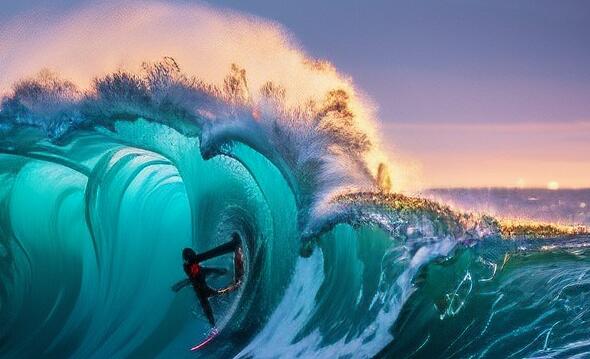
Life isn't a straight line drawn on a textbook grid where every step has to lead to the next destination. It's more like a tangled mess of dry riverbeds cutting through the granite of the earth, or maybe just a few random drops of rain hitting a rooftop and turning into thunder later. We spend so much time trying to optimize our paths to reach a specific goal, forgetting that the beauty often lies in the muddy puddles, the wrong turns, and the sudden storms that change the entire picture. I remember when I first started writing this, I copied a paragraph straight from a motivational handbook. It talked about "embracing uncertainty" and "facing the future with courage." It was nice, clean, and very American in its simplicity. But when I read it, I felt like a teenager reciting a poem from a library, missing the point entirely. Why? Because life doesn't care about your credentials, your roadmap, or whether you've pre-planned every contingency. Sometimes the best thing you can do is just get your feet wet in the dark and see what happens. The moment of truth comes when the lights go out, or when an unexpected silence falls over a crowded room. In those quiet moments, you realize that the noise you've been trying to silence is often the source of your greatest wisdom. Think about the last time you watched someone solve a difficult problem, not with a clever trick, but by making a wild, chaotic mistake. That mistake wasn't a failure; it was a raw piece of data. We all have that same instinct, that knowing voice in our heads that screams, "I can't do this," while actually everything is spinning out of control. But the truth is, how you handle the shaking ground determines whether you crumble or find your footing. It doesn't matter if the wind is blowing or if the ground is shaking; it all comes down to how you react to the force. Take the idea of resilience. In the old days, we told people to stay calm during a crisis. But life resets your clocks every time a big thing happens. When the stock market crashes, or your car breaks down in the middle of nowhere, the words "stay calm" stop being useful. What works then is admitting that you are terrified, that your heart is pounding against your ribs like a drum in a hurricane, and that it's okay to cry in your car. There's no lesson in crying; there's only the raw, unpolished feeling of loss. And when you let that feeling sit with you, it stops being painful and becomes a signal. It tells you that the system is broken, but it also tells you that you have survived to the next point. The resilience isn't standing up straight; it's learning how to stand up even when your knees are shaking and your breath is gone. Let's look at numbers for a second. In 2023, the global economy didn't just slow down; it shattered. Companies had to close stores, families moved to smaller apartments, and supply chains collapsed overnight. If you've ever watched a news report on a rainy Tuesday, you might feel that sudden, overwhelming anxiety. You wonder, "What if this is the end?" "How will my savings go?" The panic is real. But here's the thing: if you think about it, panic is just a temporary glitch in the human software. When you see a massive financial event happen, the data doesn't change forever. It just updates. The markets move up and down, the economies shift, and the stories change. But the core truth remains: systems break and fix themselves. Consider the simplicity of a young entrepreneur who started a startup in a garage by just driving a Ford F-150. This person didn't have a team, a fancy office, or a complex business plan. They just remembered to breathe, to eat, and to keep moving forward. They made a huge mistake early on, but they didn't retreat. They used that mistake as fuel. That energy, that stubbornness, that refusal to quit when things got hard—that's the engine that drives progress. When you try to follow another person's path, you risk stagnating. When you try to follow your own messy, emotional, and uncertain path, you often end up where you started, but you've grown. You've learned what you didn't know before. There's a story about a builder who wanted to build a perfect house. He measured every inch, checked the math with a calculator, and called in an architect to make sure everything fit. He spent three years trying to perfect the blueprint. But then he had an idea. He said, "What if I don't need a perfect house? What if I build a home that fits the person inside?" He stopped measuring. He stopped caring about the square footage. He just needed a place to sleep, a place to eat, and a place to feel safe. He built a shingled roof, used old wood for the floor, and lived there for three months before moving. The house didn't look exactly like the design he planned, but it was exactly what he needed. It was imperfect, and that's why it was perfect. This idea applies to everything. Your career, your relationships, your health. You don't need a perfect career path. You don't need a partner who never makes a mistake. You just need someone who shows up, who faces their challenges, and who grows alongside you. The most common mistake we make is trying to control everything. We want to plan every move, every time we talk, every decision. But life is not a puzzle to be solved; it's a conversation with yourself. You can't solve a conversation that isn't happening. Think about the phrase "midlife crisis." Everyone knows the word, but what does it actually mean? It means you're tired of pretending to be fine. It means you're staring into a mirror and seeing something you didn't think you had, and the only way out is to go out into the world and do something new. It's not about losing; it's about gaining. It's about realizing that you've spent decades trying to prove you matter, and the only way to truly matter is to live fully, not to live well. There's a quote that's become a cliché, but it's also a miracle: "You can't solve life with a plan, so just live." It sounds like nonsense, but that's the point. Life is not a math problem with a clear answer. It's a series of moments, some of which are beautiful and some of which are painful, and your job isn't to calculate the odds, it's to embrace the feeling of the moment. When you feel the sadness, breathe it in. When you feel the excitement, let it out. When you feel fear, don't run. Just go for a walk. We are so afraid of the unknown that sometimes we stop moving altogether. We hide in our rooms, checking messages, trying to predict the next turn of the wheel. But the wheel is spinning faster than we can see. Every day we spend waiting for the perfect moment is a moment we are letting go of. Every time you choose to do something without a perfect plan is a victory. It's a victory against the self-protection instinct that tells you you're not ready, that you don't know, that it's too soon. Imagine a forest. If every tree was planted perfectly according to the map, there would be no forest, just a series of uniform rows. There would be no wind, no rain, no sunlight hitting different leaves in different ways. There would be nothing. Nature doesn't plan. It reacts. It grows in wild directions, creating patterns that look like chaos but are actually the result of simple, relentless forces. Wind pushes leaves. Water erodes soil. Fire burns through the ground. These are the components. They are all messy. They are all unpredictable. But together, they create a living, breathing organism. You are that organism. You are made of the same stuff as a tree, made of the same stuff as a river, made of the same stuff as a storm. You have no idea what your future will look like, but you have to take the next step. Sometimes the step is tiny, like folding laundry or drinking coffee. Sometimes the step is massive, like starting a business or changing your entire life. Neither is "wrong." Both are necessary parts of the equation. There was a time when I felt like I was walking with my eyes closed, trying to keep my head level as the road went downhill. I wanted to stay steady, to not tip over. But then I realized that I'm not actually walking. I'm floating. The road is curved. The water is rushing. The wind is pushing. If I try to hold myself steady against the current, I will drown. If I try to steer the boat with my hands, I will capsize. I have to let go of the steering wheel. I have to just go. Just keep going. It's hard to let go. It feels like losing control. But when you lose control, you discover that you are not the master of the situation. You are just a passenger, and life is just a ride. You don't need to be the only one holding the turn signals. You don't need to be the only one judging the scenery. Sometimes, you just need to sit back and watch the next person get in. Sometimes, you just need to enjoy the view. We live in a culture that rewards productivity. We are told to be productive, to be efficient, to maximize every second. But efficiency is a tool, not a life philosophy. If you use your life purely as a tool to get a job done, you will eventually break. You will burn out. You will feel like a machine that failed. But if you use your life as a way to explore, to feel, to connect, to fail and learn, then you are something else entirely. You are a being. So, how do you handle the uncertainty? The answer is simple: you stop trying to eliminate it. You learn to live with it. You stop trying to control everything and start accepting the flow. Accept that things will go wrong. Accept that mistakes will happen. Accept that you will have bad days and good days. Accept that you will have moments of clarity and moments of chaos. One of the best ways to handle uncertainty is to focus on what is within your control. You can't control the weather, the market, or the opinions of others. But you can control your reaction to it. You can control your mindset. You can control your attitude. When the world crashes, collapse, or shift, you have a choice. You can try to calculate the outcome, or you can choose to find beauty in the mess. There's a poem I read once, and I thought about it for days. It was about a bird flying to a place it doesn't know, carrying no maps, no compass, just the instinct to fly. It didn't care if it hit a tree or hit the ground. It just flew. It didn't plan. It didn't worry. It just went. That's the lesson. That's the only lesson that matters. Not how to plan, not how to control, not how to succeed. But how to go. How to be present in the moment, even when the moment is terrifying. Even when the path is wrong. Even when you don't know where you're going. We are all just trying to make sense of a huge, confusing, beautiful, chaotic thing. We're trying to find patterns in the noise. We're trying to make sense of our own lives. And sometimes, the only way to make sense is to just get drunk, cry at the plane landing, or sit in a park until the sun goes down and watch the clouds move. The data doesn't lie. People change. Relationships break. Careers change. But the human spirit, that part of us that wants to grow, to create, and to feel deeply, is unbreakable. It's not about the data; it's about the feeling. And when you stop focusing on the outcome and start focusing on the experience, you find that life isn't a destination to be reached. It's a journey to be lived. So, go ahead. Don't look back. Don't worry about the mistakes. Don't worry about the future. Just look at the present. Breathe. Take a deep breath. And then, move forward. Even if you don't know where you're going. Even if you don't know the route. Just take that first step. That's the only thing that truly matters. The road ahead might be dark. The journey might be long. But the destination doesn't matter as much as the viewing. And the best thing you can do is just keep moving. Keep breathing. Keep living. And let the world be whatever it is, even if it's a mess. You are the mess. You are the storm. You are the rain. You are the wind. And right now, you are the one holding the umbrella. Hold the umbrella. Move forward.
相关标签: